“People were bringing even infants, presumably those so young that they needed to be carried, and other children to Jesus ‘that he might touch them.’ Perhaps they had heard of Jesus’ miraculous healing powers and wanted to gain some of that for their children. However, that is partly to impose our more caring view of children onto first-century people. The literature on how children were viewed then suggests that people then did not value children very highly. Children were, in one interpretation, seen to be on the same social level as slaves: with few rights, open to abuse, and lacking protection under Jewish law. Other, more moderate views are that children were merely treated with indifference. . . . Clearly there is more than a metaphor here; there is an emotional image for us who would be disciples to imitate. There is something about Jesus that is a blessing, a hospitality, an approachability, a charisma that draws others into him. Luke the author wants us to get that image. . . . No one can merit or achieve the kingdom; it must be received without merit, as a child receives everything. . . . We, like the disciples, are to welcome as Jesus welcomed. We are to follow the example of Jesus, who called the marginal and the despised to himself. What we can do out of gratitude is to call the socially rejected to physical and spiritual life in Christ. Like the early church, we are to transform society by not just accepting but seeking out the outcasts and the marginalized. We are to treat them as Jesus did the children. . . . Ministry to, with, and for those who are on the margins is our response to God’s welcome of us. . . . What is the quality that commends children? Precisely their dependency. Their dependence on adults mirrors our dependence of God; that is one of the marks of the kingdom, which belongs to them (v. 16b). Here is exemplified the equal unworthiness, marginality and dependence of us all before God.” Shannon Jung
“Whoever does not receive
the kingdom of God as a little child
will never enter it.”
Luke 18:17 NLT
Moving From Head to Heart
- What would a church look like that called the “socially rejected to physical and spiritual life in Christ?”
- How would that impact it’s philosophy of ministry? . . . congregational demographics?
- Have you ever been an outsider? Are there many socially rejected people in your congregation? . . . in your list of friends?
Abba, thank you for our approachable Jesus.
For More: Feasting on the Gospels, Vol. 2 by Cynthia Jarvis and E. Elizabeth Johnson, eds.

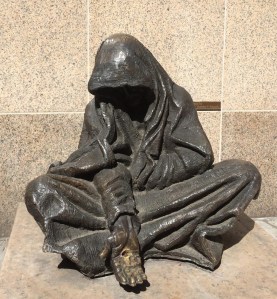 And it wasn’t just that this good Franciscan priest drank too much. I broke every one of the Ten Commandments six times Tuesday: adultery, countless acts of fornication, violence to support my addiction, character assassination to anybody who dared to criticize me or remonstrate with me. The morning I woke up in the alcoholic boozy fog, I looked down the street to see a woman coming toward me, maybe twenty-five years old, blonde, and attractive. She had her son in hand, maybe four years old. The boy broke loose from his mother’s grip, ran to the doorway, and stared down at me. His mother rushed in behind him, tucked her hand over his eyes, and said, ‘Don’t look at that filth. That’s nothing but pure filth.’ Then I felt her shoe. She broke two of my ribs with that kick. That filth was Brennan Manning, thirty-two years ago.” Brennan Manning
 Richer By Far