Daily Riches: The Most Revolutionary Man on Earth (Dietrich Bonhoeffer)

“To become free does not mean becoming great in the world, not becoming free from your brother, nor even free from God, but to become free from oneself, one’s lie. It means to become free from thinking only of myself, from being the center of my world, from hate, by which I despise God’s creation. It means to be free to be for the other: the person for others. Only God’s truth can enable me to see the other as he really is. It tears out the twisted image that I have of the other within me and shows him to me in a new light. And insofar as God’s truth does that, it bestows upon me the action, the love, the grace of God. It destroys our lies and creates the truth. It destroys hatred and creates love. God’s truth is God’s love and God’s love makes us free from ourselves for others. To be free means nothing less than to be in love. And to be in love means nothing less than being in the truth of God. The man who loves because he has been made free by God is the most revolutionary man on earth. He challenges all values. He is the explosive material of human society. He is a dangerous man. For he recognizes that the human race is in the depths of falsehood. And he is always ready to let the light of truth fall upon his darkness; and he will do this because of his love. But this disturbance, which such people bring, calls forth hatred from the world. And therefore this knight of truth and love is not the hero that men long for or honor, not one who is without enemies; but one whom they would do away with, outlaw, indeed kill.  The way of God’s truth leads to the cross. From now on, we know that all truth which is true before God must face the cross. The church that follows Christ must go with him to the cross.” Dietrich Bonhoeffer

“use your freedom to serve one another in love.”
Galatians 5:13
 .

Moving From the Head to the Heart

  • Are you aware of sometimes having “a twisted image … of the other”–perhaps based on race, religion or social status?
  • Will you “let the light of truth fall upon your darkness”–to free you to love?
  • How would it make you feel to be described as “the person for others?”
  • Are you free enough of yourself–”from being the center of your world, from hate”–to be that person?

Abba, free me of the lies I tell myself that ensnare me in hatred.

For More: Dietrich Bonhoeffer’s Christmas Sermons edited by Edwin Robertson

_________________________________________________

 Thanks for reading and sharing this blog. I appreciate your interest! – Bill

Daily Riches: The Far Too Simple Command to Love (Jonathan Martin and Thomas Merton)

“God loves you…without disclaimers. God loves you…without conjunctions. God loves you…without an addendum.” Jonathan Martin

“We have to resolutely put away our attachment to natural appearance and our habit of judging according to the outward face of things. I must learn that my fellow man, just as he is, whether he is my friend or my enemy, my brother or a stranger from the other side of the world, whether he be wise of foolish, no matter what my be his limitations, ‘is Christ.‘  …Any prisoner, any starving man, any sick or dying man, any sinner, any man whatever, is to be regarded as Christ–this is the formal command of the Savior Himself. This doctrine is far too simple to satisfy many modern Christians, and undoubtedly many will remain very uneasy with it, tormented by the difficulty that perhaps after all, this particular neighbor is a bad man, and therefore cannot be Christ. The solution of this difficulty is to unity oneself with the Spirit of Christ, to start thinking and loving as a Christian, and to stop being a hairsplitting pharisee. Our faith is not supposed …to assess the state of our neighbor’s conscience. It is the needle by which we draw the thread of charity through our neighbor’s soul and our own soul and sew ourselves together in one Christ. Our faith is given us not to see whether or not our neighbor is Christ, but to recognize Christ in him and to help our love make both him and ourselves more fully Christ.  …corrupt forms of love wait for the neighbor to ‘become a worthy object of love’ before actually loving him. This is not the way of Christ. Since Christ Himself loved us when we were by no means worthy of love and still loves us with all our unworthiness, our job is to love others without stopping to inquire whether or not they are worthy. …What we are asked to do is to love; and this love itself will render both ourselves and our neighbor worthy if anything can. Indeed, that is one of the most significant things about the power of love. There is no way under the sun to make a man worthy of love except by loving him. As soon as he realizes himself loved–if he is not so weak that he can no longer bear to be loved–he will feel himself instantly becoming worthy of love. He will respond by drawing a mysterious spiritual value out of his own depths, a new identity called into being by the love that is addressed to him.” Thomas Merton

From Head to Heart

  • Why do we find so many reasons not to love?

Abba, teach me to love.

For More: Disputed Questions by Thomas Merton

Daily Riches: The Healing Power of Love (Brennan Manning and Fred Rogers)

“Healing is a response to a crisis in the life of another person. It’s enough of a response, a satisfactory response to a crisis in the life of another. And wherever the word crisis is used in the Greek New Testament, it is translated in English as judgment. That’s right—judgment. Healing is a response that I make to a decisive moment in the life of a brother or sister; whether I respond or not, I have made a judgment. Healing becomes the opportunity to pass off to another human being what I have received from the Lord Jesus; namely His unconditional acceptance of me as I am, not as I should be. He loves me whether in a state of grace or disgrace, whether I live up to the lofty expectations of His gospel or I don’t. He comes to me where I live and loves me as I am. When I have passed that same reality on to another human being, the result most often has been the inner healing of their heart through the touch of my affirmation. To affirm a person is to see the good in them that they cannot see in themselves and to repeat it in spite of appearances to the contrary. Please, this is not some Pollyanna optimism that is blind to the reality of evil, but rather like a fine radar system that is tuned in to the true, the good, and the beautiful. When a person is evoked for who she is, not who she is not, the most often result will be the inner healing of her heart through the touch of affirmation.” Brennan Manning

“I believe that appreciation is a holy thing–that when we look for what’s best in a person we happen to be with at the moment, we’re doing what God does all the time. So in loving and appreciating our neighbor, we’re participating in something sacred.” Fred Rogers

“Love … hopes all things”
1 Corinthians 13

Moving From the Head to the Heart

  • When someone comes to you in crisis, what kind of “judgment” do you usually make?
  • Do you try to see the good in someone that they can’t even see in themselves? …to “hope” for great things for them?
  • Do believe that your love for someone can powerfully heal them? Are you out there, “giving it a try” somewhere in your world?

Abba, teach me to love.

For More: The Furious Longing of God by Brennan Manning

_________________________________________________

These “Daily Riches” are for your encouragement as you seek after God and he seeks after you. I hope you’ll follow my blog, and share it. I appreciate your interest! Please leave a comment or question. –  Bill (Psalm 90:14)

“I practice daily what I believe; everything else is religious talk.”


Daily Riches: A View from the Bottom (Richard Rohr)

“In almost all of history, the vast majority of people understood the view from the bottom due to their own life circumstance. Most of the people who have ever lived on this planet have been oppressed and poor. But their history was seldom written except in the Bible (until very recently in such books as Howard Zinn’s A People’s History of the United States). Only in modern times and wealthy countries do we find the strange phenomenon of masses of people having an establishment mentality. This relatively new thing called ‘the middle class’ gives many of us just enough comfort not to have to feel the pinch or worry about injustice for ourselves. Most of us in the Northern Hemisphere have a view from the top even though we are nowhere near the top ourselves. The mass of people can normally be bought off by just giving them ‘bread and circuses,’ as the Romans said. …Only by solidarity with other people’s suffering can comfortable people be converted. Otherwise we are disconnected from the cross–of the world, of others, of Jesus, and finally of our own necessary participation in the great mystery of dying and rising. In the early Christian Scriptures, or the ‘New’ Testament, we clearly see that it’s mostly the lame, the poor, the blind, the prostitutes, the drunkards, the tax collectors, the sinners–those on the bottom and the outside–that really hear Jesus’ teaching and get the point and respond to him. It’s the leaders and insiders (the priests, scribes, Pharisees, teachers of the law, and Roman leaders) who crucify him. That is evident in the text. …After Jesus’ death and resurrection, the first Christians go ‘underground.’ They are the persecuted ones, meeting in secrecy in the catacombs. …The Church was largely of the poor and for the poor. The turning point, at which the Church moved from the bottom to the top, is the year 313 A.D. when Emperor Constantine supposedly did the Church a great favor by beginning to make Christianity the established religion of the Holy Roman Empire. …As the Church’s interests became linked with imperial world views, our perspective changed from the view from the bottom and powerlessness (the persecuted, the outsiders) to the view from the top where we were now the ultimate insiders (with power, money, status, and control).” Richard Rohr

“Once you were not a people”
1 Peter 2:!0

Moving From Head to Heart

  • Do you have friends on the “bottom” or “outside?” What does your answer say about you?
  • Compared to the world’s population, do you have “power, money, status, and control?”
  • What “bread and circuses” could be distracting you from harsh realities?

Jesus, convert us, your comfortable people.

For More: Scripture as Liberation by Richard Rohr

_________________________________________________

Thanks for reading/sharing my blog! – Bill


Daily Riches: Jesus’ Reverse Mission (Richard Rohr)

“One reason we Christians have misunderstood many of Jesus’ teachings is that we have not seen Jesus’ way of education as that of a spiritual master. He wants to situate us in a larger life, which he calls the ‘Reign of God.’ But instead we make him into a Scholastic philosopher if we are Roman Catholic, into a moralist if we are mainline Protestant, or into a successful and imperialistic American if we are Evangelical. Yet the initiatory thrust of Jesus’ words is hidden in plain sight. Study, for example, his instructions to the twelve disciples, when he sent them into society in a very vulnerable way (no shoes or wallet, like sheep among wolves). How did we miss this? Note that it was not an intellectual message as much as it was an ‘urban plunge,’ a high-risk experience where something new and good could happen. It was designed to change the disciples much more than it was meant for them to change others! (See Matthew 10:1-33 or Luke 10:1-24.) Today we call it a reverse mission, where we ourselves are changed and helped by those whom we think we are serving. When read in light of classic initiation patterns, Jesus’ intentions are very clear. He wanted his disciples–then and now–to experience the value of vulnerability. Jesus invites us to a life without baggage so we can learn how to accept others and their culture. Instead, we carry along our own country’s assumptions masquerading as ‘the good news.’ He did not teach us to hang up a shingle to get people to attend our services. He taught us exactly the opposite: We should stay in their homes and eat their food! This is a very strong anti-institutional model. One can only imagine how different history would have been had we provided this initiatory training for our missionaries. We might have borne a message of cosmic sympathy instead of imperialism, providing humble reconciliation instead of religious wars and the murdering of ‘heretics,’ Jews, ‘pagans,’ and native peoples in the name of Jesus.” Richard Rohr

“Do not take a purse or bag or sandals”
Jesus, in Luke 10:4

Moving From Head to Heart

  • Can you imagine how different history would be if the church had followed the instructions (and personal example) of Jesus when it comes to doing ministry?
  • Are you willing to “plunge” into a risky experience “where something new and good could happen” to you?
  • Have you been helped in the process of helping others? Is God calling you to your own “reverse mission?”

Abba, lead me out of my comfort zone, and heal me as I heal others.

For More: Adam’s Return by Richard Rohr

_________________________________________________

Thanks for reading/sharing my blog! – Bill

“I practice daily what I believe; everything else is religious talk.”

Daily Riches: The Alternative to Religious Liberty (Robert J. Morgan)

“For years England had seesawed between Catholic and Protestant mandates, depending on the monarch in power. When the king was Catholic, Protestants were burned. When Protestant, Catholics died. In both situations, Puritans and non-Anglicans (Dissenters) were hunted down with such vengeance that they finally rebelled. King Charles I was beheaded, his young son fled to France, and a Puritan government was installed. But the people missed their monarchy, and in 1658 young Charles II headed home from France promising religious liberty. He entered London on his thirtieth birthday, May 29, 1660. Twenty thousand soldiers escorted the young king through flower-strewn streets. Trumpets blared, crowds cheered, bells pealed from every tower. His love life and his dubious faith in God made him the most scandalous leader of his time. But his easy smile and approachability caused few to dislike him. Some did. In 1661 a pack of religious fanatics known as Fifth Monarchy Men tried to overthrow him and set up a kingdom awaiting the return of Christ. They failed, but the experience left Charles more suspicious of Dissenters than ever. Such preachers as John Bunyan found themselves languishing in prison, and a series of laws put the screws to Dissenters. Five different acts were passed: (1) the Corporation Act of 1661 excluded all Dissenters from local government; (2) the Act of Uniformity in 1662 required all ministers to use The Book of Common Prayer as a format for their services. It was this act that drove 2,000 preachers from their pulpits in a single day; (3) the Conventicle Act of 1664, aimed primarily at Baptists, forbade religious meetings by Dissenters; (4) the Five Mile Act of 1665 prohibited dissenting ministers from coming within five miles of any city or town in which they had ministered; and (5) the Test Act of 1673 excluded Catholics from civil and military positions. Baptists, Catholics, Quakers, Presbyterians, and Congregationalists all found themselves again under the lash. In the jail. At the stake.” Robert J. Morgan

“For to us a child is born, to us a son is given …
And he will be called …Prince of Peace.”
Isaiah 9:6

Moving From the Head to the Heart

  • Do you read this story as a frightening example of the legislation of religious bigotry and prejudice? …as violence fueled by fear and intolerance?
  • Is defending the your own religious liberty and that of others who differ from you (like Muslims) important to you? If not, why not?
  • Can you imagine Jesus treating religious bigotry, hatred and intolerance as virtuous?
  • Are you thinking, “This could never happen here?”

Abba, deliver us from the evil one. As people of faith, may we be known as people of love.

For More: On This Day by Robert J. Morgan

_________________________________________________

Thanks for reading/following my blog! –  Bill (Psalm 90:14)

“I practice daily what I believe; everything else is religious talk.”

Daily Riches: Religion and Violence (Jonathan Sacks and Dan Clendenin)

“Sibling rivalry is ‘the most primal form of violence,’ and ‘the dominant theme of the book of Genesis.’  We desire what others have, become rivals for it, and then fight to get it in what we wrongly think is a zero sum game. And so Jews, Christians and Muslims all claim to be the one, true heir of Abraham. We fight to be the sole inheritor of the divine promise. The stories are familiar to those who know their Bibles, but in Sacks’s ‘close reading’ of them, he offers new interpretations in which sibling rivalry is revealed and then subverted. With Isaac and Ishmael, God chooses Isaac, but he doesn’t reject Ishmael. The story of Jacob and Esau is ‘the refutation of sibling rivalry in the Bible.’ Recall how Jacob returned the blessing that he stole from his blind father Isaac. The story of Joseph and his brothers who tried to kill him takes up a third of the book of Genesis—in the end, the victim forgives and the perpetrators repent. Rachel and Leah exemplify the ‘rejection of rejection.’ Sibling rivalry is natural, says Sacks, but these stories remind us that it’s not inevitable. Human beings cannot live without a group identity, and religion might be the most powerful of them all. By definition, groups require an Us and a Them. …There’s no middle ground, no subtlety or nuance, only black and white, in and out. By nature, we extend altruism toward my In group, and hostility toward my Out group. Here again the Hebrew revelation subverts our natural inclinations by commending a radical role reversal. Do not oppress the stranger, the people outside your group. Why? Because you know what it’s like to be oppressed as a stranger in a strange land (Exodus 22.21).  …have mercy on them, remember that you too were once aliens. …Protect the weak, care for widows and orphans, help the poor, speak up for those who have no voice. Do justice, love kindness. Don’t long for power, for you can’t impose faith or truth by force. Religion, argues Sacks, is an anti-politics that lives without power. Instead, it persuades by example.” Dan Clendenin

“Do not seek revenge or bear a grudge against a fellow Israelite,
but love your neighbor as yourself.
Leviticus 19:18

Moving From Head to Heart

  • Does your religion subvert the tendency to create “insiders” and “outsiders?”
  • Does your religion persuade by power … or example?
  • Is there any good reason why Jews, Christians and Muslims must fight with each other? Can you imagine ways we might be able to learn from each other?

Abba, help me see others as insiders, included with me in your love.

For More: Not in God’s Name by Jonathan Sacks

_________________________________________________

Thanks for reading/following my blog! –  Bill (Psalm 90:14)


Daily Riches: Fanny Crosby – The Blind Angel of the Bowery (Robert Morgan)

“Fanny Crosby, the blind hymnist, was asked to speak to a group of blue collar workers [in Cincinatti]. Near the end of her address, she had an overwhelming sense that ‘some mother’s boy’ before her ‘must be rescued that night or not at all.’ She mentioned this to the crowd, pleading, ‘If there is a dear boy here tonight who has perchance wandered away from his mother’s home and his mother’s teaching, would he please come to me at the close of the service?’ Afterward a young man of about eighteen approached her, ‘Did you mean me?’ he asked. ‘I promised my mother to meet her in heaven, but the way I have been living, I don’t think that will be possible now.’ Fanny had the joy of leading him to Christ. Returning to her room that night, all she could think about was the theme ‘rescue the perishing,’ and when she retired that night she had written the complete hymn. …Many years later, Fanny was speaking at the YMCA in Lynn, Massachusetts, and she recounted the story behind ‘Rescue the Perishing.’ After the service, a man approached her, his voice quivering. ‘Miss Crosby,’ he said, ‘I was that boy who told you more than thirty-five years ago that I had wandered from my mother’s God. That evening you spoke, I sought and found peace, and I have tried to live a consistent Christian life ever since. If we never meet again on earth, we will meet up yonder.’ He turned and left, unable to say another word. But Fanny later described it as one of the most gratifying experiences of her life. …This song served as a prelude to Fanny Crosby’s second career. About age sixty, she began working downtown rescue missions, spending several days a week in lower Manhattan, witnessing to the down-and-out. Despite her fame as a hymnwriter, she chose to live in near poverty in New York’s ghettos, for she felt a calling to minister to the needy. Just a few blocks from her little tenement apartment was the Bowery, a haunt for alcoholics and where every kind of vice flourished. There Fanny would go day after day to rescue the perishing.” Robert Morgan

“Down in the human heart,
crushed by the tempter,
feelings lie buried that grace can restore.
Touched by a loving heart,
wakened by kindness,
chords that are broken
will vibrate once more.
Rescue the perishing,
care for the dying.
Jesus is merciful,
Jesus will save.”
Fanny Crosby

“the Son of Man came
to seek and to save the lost.”
Luke 19:10

Moving From the Head to the Heart

  • Have you experienced the miracle that can result from the “touch” of a loving heart?
  • If you’re not ministering to others, is there some good reason?
  • Imagine moving to the Bowery in your sixties. Are you available to God like that?

Abba, some are so crushed by the tempter, they’re seem beyond being helped–the “perishing”, the “dying.” Use me to rescue them just the same.

For More: Then Sings My Soul by Robert Morgan

_________________________________________________

Thanks for reading/following my blog! –  Bill (Psalm 90:14)


Daily Riches: Don’t Walk By (Deepti Hajela and Henri Nouwen)

“The homeless man lay face down, unmoving, on the sidewalk outside an apartment building, blood from knife wounds pooling underneath his body. One person passed by in the early morning. Then another, and another. Video footage from a surveillance camera shows at least seven people going by, some turning their heads to look, others stopping to gawk. One even lifted the homeless man’s body, exposing what appeared to be blood on the sidewalk underneath him, 20150507_211748-1before walking away. It wasn’t until after the 31-year-old Guatemalan immigrant had been lying there for nearly an hour that emergency workers arrived, and by then, it was too late. Hugo Alfredo Tale-Yax …had died. ‘I think it’s horrific,’ said Marla Cohan, who teaches at P.S. 82, a school across the street…. ‘I think people are just afraid to step in; they don’t want to get involved; who knows what their reasons are?’ Tale-Yax was walking behind a man and a woman on 144th Street in the Jamaica section of Queens around 6 a.m. April 18 when the couple got into a fight that became physical, according to police, who pieced together what happened from surveillance footage and interviews with area residents. Tale-Yax was stabbed several times when he intervened to help the woman….” Deepti Hajela
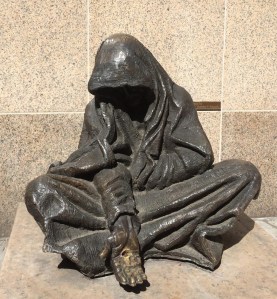
“One of the hardest spiritual tasks is to live without prejudices. Sometimes we aren’t even aware how deeply rooted our prejudices are. We may think that we relate to people who are different from us in colour, religion, sexual orientation, or lifestyle as equals, but in concrete circumstances our spontaneous thoughts, uncensored words, and knee-jerk reactions often reveal that our prejudices are still there. Strangers, people different than we are, stir up fear, discomfort, suspicion, and hostility. They make us lose our sense of security just by being ‘other.’ Only when we fully claim that God loves us in an unconditional way and look at ‘those other persons’ as equally loved can we begin to discover that the great variety in being human is an expression of the immense richness of God’s heart. Then the need to prejudge people can gradually disappear.” Henri Nouwen

“with the measure you use, it will be measured to you.”
Jesus, in Matthew 7:2

Moving From the Head to the Heart

  • Are you aware of the negative forces at work in your life? (apathy, fear, anger, hurry)
  • Will you commit to following Jesus in his love for Others–in spite of such forces?
  • Will you allow him to show you his great love for you–and for Others–in the process?

Abba, we claim your great unconditional love for ourselves, and for all.

For more: Bread for the Journey by Henri Nouwen

_________________________________

Thanks for reading and sharing my blog! Please leave a comment. – Bill

Daily Riches: That Filth on the Street (Brennan Manning)

“Ironically it was April Fool’s Day, 1975, 6:30 a.m., and I woke up in a doorway on Commercial Boulevard in Fort Lauderdale, Florida. I was thick in an alcoholic fog, sniffing vomit all over my sweater, staring down at my bare feet. I didn’t know a wino would steal my shoes during the night to buy a bottle of Thunderbird, but one did. I had been out on the street for a year and a half, drunk every day, sleeping on the beach until the cops chased me away. You could find me in doorways or under the bridge, always clutching my precious little bottle of Tequila.13071807_10156744822040251_2539662960200497518_o And it wasn’t just that this good Franciscan priest drank too much. I broke every one of the Ten Commandments six times Tuesday: adultery, countless acts of fornication, violence to support my addiction, character assassination to anybody who dared to criticize me or remonstrate with me. The morning I woke up in the alcoholic boozy fog, I looked down the street to see a woman coming toward me, maybe twenty-five years old, blonde, and attractive. She had her son in hand, maybe four years old. The boy broke loose from his mother’s grip, ran to the doorway, and stared down at me. His mother rushed in behind him, tucked her hand over his eyes, and said, ‘Don’t look at that filth. That’s nothing but pure filth.’ Then I felt her shoe. She broke two of my ribs with that kick. That filth was Brennan Manning, thirty-two years ago.” Brennan Manning

“For I was hungry and you gave me something to eat,
I was thirsty and you gave me something to drink,
I was a stranger and you invited me in,
I needed clothes and you clothed me,
I was sick and you looked after me,
I was in prison and you came to visit me.’
“Then the righteous will answer him,
‘Lord, when did we see you hungry and feed you,
or thirsty and give you something to drink?
When did we see you a stranger and invite you in,
or needing clothes and clothe you?
When did we see you sick or in prison
and go to visit you?’
“The King will reply, ‘Truly I tell you,
whatever you did
for one of the least of these brothers and sisters of mine,
you did for me.’
Jesus, in Matthew 25:35-40

Moving From Head to Heart

  • Notice how the woman saw the drunken priest as a “that.”
  • Imagine, breaking the ribs of Jesus with your kick.
  • In this story would you be the woman or the priest?

Abba, teach my eyes to see the precious person behind the distressing disguise.

For More: The Furious Longing of God by Brennan Manning

_________________________________________________

Thanks for reading/sharing my blog! – Bill

Daily Riches: Religion, Violence … and Hope (Dan Clendenin and Jonathan Sacks)

“Human beings cannot live without a group identity, and religion might be the most powerful of them all.  By definition, groups require an Us and a Them. …’You’re either for us or against us.’ There’s no middle ground, no subtlety or nuance, only black and white, in and out. By nature, we extend altruism toward my In group, and hostility toward my Out group. Here again the Hebrew revelation subverts our natural inclinations by commending a radical role reversal. Do not oppress the stranger, the people outside your group. Why? Because you know what it’s like to be oppressed as a stranger in a strange land (Exodus 22.21). The Hebrew word ger (alien, immigrant) occurs 92 times in the Jewish Scriptures, along with similar words like toshav (migrant), zar (stranger or outsider), and nocri (foreigner). Don’t oppress the stranger, have mercy on them, remember that you too were once aliens. ‘Do not seek revenge or bear a grudge against anyone among your people,’ says Leviticus 19:18, ‘but love your neighbor as yourself.’ Protect the weak, care for widows and orphans, help the poor, speak up for those who have no voice. Do justice, love kindness. Don’t long for power, for you can’t impose faith or truth by force. Religion … is an anti-politics that lives without power. Instead, it persuades by example. Demographers tell us that people of religion will increase in the coming decades, whereas secular populations will decrease. Problems of religiously motivated violence are here to stay, at least in some form. We must reclaim our common humanity that takes precedence over our religious differences. …Ironically, whereas the roots of human violence are found in religion, so too is its subversion, for the original Abrahamic promise was that ‘through you all the families of the earth will be blessed.’  To bless the Other, not to curse him, is the sign and spirit of true faith.” Dan Clendenin

 “In that day Egypt and Assyria … will move freely between their lands, and they will both worship God. In that day Israel will be the third, along with Egypt and Assyria, a blessing in the midst of the earth. For the Lord of Heaven’s Armies will say, ‘Blessed be Egypt, my people. Blessed be Assyria, the land I have made. Blessed be Israel, my special possession!’” Isaiah 19:23-25

Moving From the Head to the Heart

  • Do you think in terms of “us” and “them?”
  • Does your political or religious group encourage hate for outsiders?
  • Isaiah reminds us God loves and will bless not only Israelis, but Egyptians and Assyrians. Are you determined to love without borders?

Abba, make my faith subversive to the kingdom of violence.

For More: Not in God’s Name: Confronting Religious Violence by Jonathan Sacks

_________________________________________________

Thanks for following and sharing my blog. – Bill

Daily Riches: The Inaccessibly Transcendent Christ (Charles Marsh, Dietrich Bonhoeffer, Myles Horton)

“A Union student from east Tennessee named Myles Horton met him after he returned from his first visit to Abyssinian [Baptist Church.] Bonhoeffer, Horton recalled, was in an expansive mood and eager to talk. Horton accompanied him on a most animate walk down Riverside Drive, the whole way Bonhoeffer speaking excitedly–in both English and German, which Horton did not understand–of the preaching, the congregant’s participation, and ‘especially the singing of black spirituals.’ He conveyed the thrill of the flock voicing ascent with the preacher. Completely unguarded, at one point Bonhoeffer stopped abruptly and told Horton that this morning in Harlem was the only time ‘he had experienced true religion in the United States.’ Indeed, he had never seen such joy in worship anywhere before, certainly not in the melancholy north German plains. Bonhoeffer concluded that ‘only among blacks, who were oppressed, could there be any real religion in this country.’ His presence at Abyssinian that year coincided with important changes in Powell’s vocation as an urban minister. A skilled administrator as well as an eloquent preacher, Powell had already been senior pastor at the neo-Gothic church for more than twenty years. But with the Great Depression sweeping over the neighhorhoods of Harlem as bad as anywhere, he felt summoned to new convictions. For most of his ministry, he had traded comfortably on a notion of Christ as inaccessibly transcendent, the God-man in majesty. Lately, he had begun to dwell on Jesus as the one who wandered into distressed and lonely places to share the struggles of the poor as a friend and counselor. Bonhoeffer’s later formulation of the ‘Christological incognito’ bears the impress of Powell’s decisive awakening, of Christ going incognito into the world, ‘an outcast among outcasts,’ hiding himself in weakness.” Charles Marsh

“Like one from whom people hide their faces
he was despised, and we held him in low esteem”
Isaiah 53:3

Moving From Head to Heart

  • Does your understanding of Christ make him so lofty and powerful that he seems distant and inaccessible? Is there a place in your religion for the “despised” sufferer of Isaiah–who “shares the struggles of the poor as a friend and counselor?”
  • Would the Christ that your congregation worships have sufficed for Harlem’s forgotten people in the midst of the Great Depression?
  • When you think of Jesus, do you think of “an outcast among outcasts … hiding himself in weakness?” Would making room for such a Jesus lead you to some kind of “awakening?”

Abba, grant me a decisive awakening to Christ incognito in my day, in my world.

For More: Strange Glory: A Life of Dietrich Bonhoeffer by Charles Marsh

_________________________________________________

These “Daily Riches” are for your encouragement as you seek God and he seeks you. I hope you’ll follow/share my blog. – Bill

Daily Riches: Testing Christianity in Harlem (Thomas Merton and Catherine de Hueck)

“Few Catholics stop to think that Communism would make very little progress in the world, or none at all, if Catholics really lived up to their obligations, and really did the things Christ came on earth to teach them to do: that is, if they really loved one another, and saw Christ in one another, and lived as saints, and did something to win justice for the poor. For, she said, if Catholics were able to see Harlem, as they ought to see it, with the eyes of faith, they would not be able to stay away from such a place. Hundreds of priests and lay-people would give up everything to go there and try to do something to relieve the tremendous misery, the poverty, sickness, degradation and dereliction of a race that was being crushed and perverted, morally and physically under the burden of a colossal economic injustice. … If Catholics, she said, were able to see Harlem as they should see it, with the eyes of faith, as a challenge to their love of Christ, as a test of their Christianity, the Communists would be able to do nothing there. But, on the contrary, in Harlem the Communists were strong. They were bound to be strong. They were doing some of the things, performing some of the works of mercy that Christians should be expected to do. If some Negro workers lose their jobs, and are in danger of starving, the Communists are there to divide their own food with them, and to take up the defense of their case. If some Negro is dying, and is refused admission to a hospital, the Communists show up, and get someone to take care of him, and furthermore see to it that the injustice is publicized all over the city. If a Negro family is evicted, because they can’t pay the rent, the Communists are there, and find shelter for them, even if they have to divide their own bedding with them. And every time they do these things, more and more people begin to say: ‘See, the Communists really love the poor!'” Thomas Merton, loosely quoting Catherine de Hueck

“Those who give to the poor will lack nothing,
but those who close their eyes to them
receive many curses.”
Proverbs 28:27

Moving From the Head to the Heart

  • Would anyone say of your church, “They really love the poor!”?
  • Is “loving the poor” central to your life of faith? (It was for Christians at least up to the time of the Reformation.)
  • Do you know any Christians who live like the Communists Merton describes? I do. It’s not a fantasy.

Abba, teach us to love.

For More: The Seven Storey Mountain by Thomas Merton

_________________________________________________

Thanks for reading/sharing this blog! – Bill

Daily Riches: Come and See Evangelism (Phyllis Tickle, David Fitch, David Di Sabatino and St. Francis)

“Your life is your theology and your sermon. Don’t preach the good news, but be the good news … Preach as you go! Preach the gospel at all times, and when necessary, use words.” Francis of Assisi

“The general tendency in Emergence Christian theology is to question with real vigor and precision whether or not the connection between faith and doctrinal precision is essential to the soul’s salvation. Dogma, yes, but doctrine, not so much. That is, do one’s brainwaves and verbal utterances actually make one’s faith? Emergence Christians can often take this even a step further and reference those places of spiritual primacy where Jesus taught (as in his judgment of the nations as told in the Gospel of Matthew, for example) that a life is what constitutes and demonstrates a disciple, rather than a mind-set.” Phyllis Tickle

“For postmodern evangelism, this means that truth is best communicated as it is lived in the life of a body of Christ out of its (his)story and its stories, not one-on-one combat via evidentiary apologetic. Instead, the church itself becomes the apologetic. As the truth of the gospel is worked out in the real lives of people living together in community, its veracity cannot be debated or individualized, it’s reality is something into which we may simply invite others to ‘come and see’ and the church thereby becomes the center for evangelism. Evangelicals often preach that what the culture needs is absolute truth, but what the culture needs is a church that believes the truth so absolutely it actually lives it out.” David Fitch

“Silence every radio and television preacher, stop every evangelical book or tract from being published, take down every evangelical website from the net and simply ask Christians to show one tangible expression of Jesus’s love to another person every day. We would be far better off.” David Di Sabatino

“Come, see a man who told me everything I ever did.
Could this be the Messiah?”
John 4:29

Moving From the Head to the Heart

  • If Jesus was going to evaluate your relationship to him more by your life (your behavior) than your mind-set (your beliefs), would you need to make some changes?
  • Which will be more persuasive with people you know–”absolute truth” from you, or “unconditional love?”
  • Are people more or less interested in God after they spend time with you?
  •  If you showed “one tangible expression of Jesus’s love to another person every day”, how different would that be from what you’re doing now?

Abba, move my “faith” into my hands and my feet.

For More: The Great Giveaway by David Fitch

_________________________________________________

These “Daily Riches” are for your encouragement as you seek after God and he seeks after you. I hope you’ll follow and share my blog. – Bill

Daily Riches: Never a Man Like This (Dorothy Sayers and Sara Bessey)

“What is repugnant to every human being is to be reckoned always as a member of a class and not as an individual person.” Dorothy Sayers

“Perhaps it is no wonder that the women were … last at the Cross [and first at the tomb!]. They had never known a man like this Man–there never has been such another. A prophet and teacher who never nagged at them, never flattered or coaxed or patronised; who never made arch jokes about them … who rebuked without querulousness and praised without condescension; who took their questions and arguments seriously; who never mapped out their sphere for them, never urged them to be feminine or jeered at them for being female; who had no axe to grind and no uneasy male dignity to defend; who took them as he found them and was completely unself-conscious. There is no act, no sermon, no parable in the whole Gospel that borrows its pungency from female perversity; nobody could possibly guess from the words and deeds of Jesus that there was anything ‘funny’ about woman’s nature.” Dorothy Sayers

“After years of reading the Gospels and the full canon of Scripture, here is, very simply, what I learned about Jesus and the ladies: he loves us. He loves us. On our own terms. He treats us as equals to the men around him; he listens; he does not belittle; he honors us; he challenges us; he teaches us; he includes us—calls us all beloved. Gloriously, this flies in the face of the cultural expectations of his time—and even our own time. Scholar David Joel Hamilton calls Jesus’ words and actions toward women ‘controversial, provocative, even revolutionary.'”  Sara Bessey

“Women aged fifteen through forty-five are more likely to be maimed or die from male violence than from cancer, malaria, traffic accidents, and war combined. One-third of women face abuse at home. …in most countries, between 30 and 60 percent of women had experienced physical or sexual violence by a husband or a boyfriend. Up to 70 percent of female murder victims are killed by their male partners.” Bessey

“So God created human beings in his own image.
In the image of God he created them;
male and female he created them.”
Genesis 1:27

Moving From the Head to the Heart

  • Do you automatically see a women first as “a member of a class and not an individual” …made in God’s image?
  • Does the kind of love-of-women Jesus demonstrated characterize your family? Is it a value preached in your church?
  • Men, is your goal to be “a man like this man”–like Jesus–who prizes and honors women?

Abba, help me be more like Jesus in my relationships with women.

For More: Jesus Feminist by Sara Bessey

_________________________________________________

Thanks for following and sharing my blog! – Bill